

1.1 Electrolytic Aluminium Production outside China
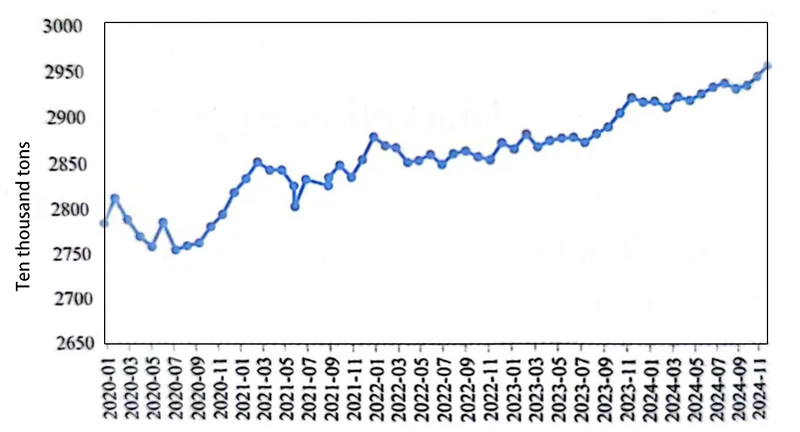
According to statistics from the International Aluminium Institute (IAI), from January to November 2024, the global cumulative production of electrolytic aluminium (excluding China) was 24.31 million tons, a slight increase of 0.7% compared to the same period last year, and there was no significant change in overall supply capacity compared to the end of last year. The average daily output in November 2024 was 81,000 tons, an increase of 1.5% compared to the beginning of the year.
Figure 1-1 Daily Electrolytic Aluminium Production outside China
Source: IAI
Since 2024, there have been continuous reports of production resumptions, reductions or shutdowns in overseas aluminium plants. The resumption of production involves a capacity of approximately 324,000 tons/year. On January 1, 2024, Alcoa announced an investment of US$181 million to restart the San Ciprian aluminium production plant in Spain. The plant will be restarted in stages from January 2024, and the entire restart process is expected to be completed by October 2025. Between October 2025 and 2026, the minimum production of the plant should reach 75% of its original capacity. However, the plant has long had the problem of high energy costs, and the expected restart process is slow. With the fall in energy prices, some electrolytic aluminium plants in Europe are also preparing to resume production, but this involves a small-scale production. Trimet plans to restart German and French aluminium plants to full capacity by mid-2025, involving an annual production capacity of about 270,000 tons/year. In January 2024, Alcoa's Warrick smelter restarted a production line of electrolytic cells that had been shut down since July 2022, involving an annual production capacity of 54,000 tons/year. Overall, although overseas electrolytic aluminium production has resumption plans, the overall resumption progress is slow. The reduction involves a capacity of approximately 488,000 tons/year. In late January 2024, Magnitude 7 Metals' electrolytic aluminium plant (annual production capacity of 263,000 tons) in Maiston Town, southeast Missouri, USA, announced that it will reduce production mainly due to expensive fossil fuels and severe cold weather. Although Magnitude 7 Metals has stated that it is trying to obtain new investments from potential investors to reopen the smelter in the future, the hope is very slim at the moment. After the closure of the aluminium plant, the production capacity in North America will further decline. In August, the Tiwai Point electrolytic aluminium plant in New Zealand, owned by Rio Tinto, was constrained by electricity supply and once again reduced its electricity consumption by 20 MW. Currently, the annual production capacity of the Tiwai Point plant is about 345,000 tons, and this power reduction is expected to lead to a decrease in aluminium production of about 125,000 tons. In September, the Press Metal Aluminium Holdings Bhd, a subsidiary of Samalaju Industrial Park in Malaysia, encountered a fire in its third-phase electrolytic aluminium project, resulting in the temporary shutdown of about 100 electrolytic cells, affecting an annual production capacity of about 100,000 tons. In terms of new investment, Indonesia's Huayin Aluminium Co. put partially into operation a 250,000 tons/year electrolytic aluminum project.
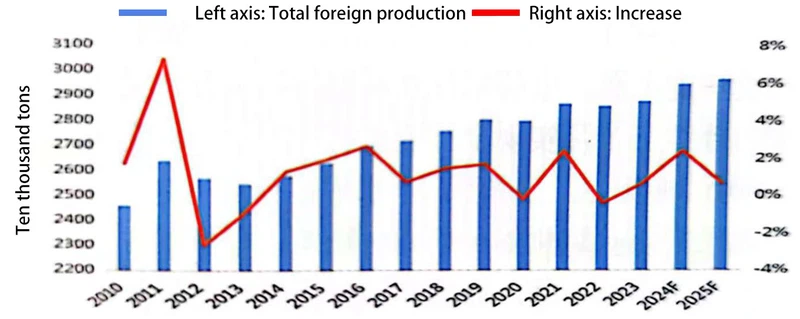
Antaike statistics show that as of the end of 2024, the total global electrolytic aluminium production capacity was 78.86 million tons/year, and the production capacity outside China totaled 34.24 million tons/year, which was the same as the previous year. The global electrolytic aluminium production in 2024 was about 72.96 million tons, an increase of 3.5% compared to the previous year. Among them, foreign electrolytic aluminium production was 29.5 million tons, an increase of 2.4% year-on-year, accounting for 40.4% of the total global production.
Figure 1-2 Foreign Electrolytic Aluminium Production from 2010 to 2025F
Source: Antaike
1.2 Electrolytic Aluminium Production in China
In 2024, China's electrolytic aluminium production capacity continued to increase, with no frequent and large-scale production fluctuations. On the one hand, Yunnan's power supply is sufficient, and the restart of electrolytic aluminium production in the province has not been reduced throughout the year, which is the main driving factor for the growth of electrolytic aluminium production this year. At the same time, high aluminium prices have also stimulated the release of some idle production capacity and new investment projects. Although since November, some regions have reduced their operating rates due to severe losses, the scale of production reduction has limited impact on the annual production. Overall, the scale of new additions and restarts in 2024 far exceeded the scale of production reduction, and the production increased at a faster pace than expected.
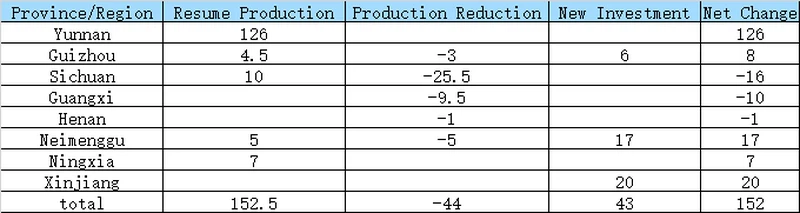
Antaike statistics show that the cumulative electrolytic aluminium production reduction in China in 2024 was 440,000 tons/year, mainly due to the reduction of some aluminium plants since November due to severe losses. The production capacity resumed throughout the year was 1.53 million tons/year, most of which were the restarted production capacity in Yunnan and other regions that were shut down due to power shortages in 2023, and a small part came from projects put into operation after technical transformation. The new investment production capacity was 430,000 tons/year. As of the end of December 2024, China's electrolytic aluminium built production capacity was 44.62 million tons/year, an increase of 190,000 tons/year compared to the previous year; the operating production capacity was 43.61 million tons/year, an increase of 1.52 million tons/year from the beginning of the year.
Table 2-1 Changes in China's Electrolytic Aluminium Production Capacity in 2024 (10,000 tons/year)
Source: Antaike
From the perspective of the time of capacity changes, the reduction occurred in the fourth quarter, and large-scale resumed production mainly concentrated in the second quarter, with new production capacity mainly concentrated in the third and fourth quarters. Due to the smaller scale of production reduction and the later time it occurred, its impact on the operating rate of that quarter was limited, and the overall production capacity of the industry showed a trend of increasing each quarter. By November, the operating rate reached 98.0%, the highest level of the year and the highest historical level. In December, the impact of production reduction began to show, and the operating rate fell to 97.7%, but still maintained at a relatively high level.
The new production capacity in 2024 was 430,000 tons/year, and the new projects were mainly concentrated in Inner Mongolia, Xinjiang, and Guizhou, all of which are new construction projects after the replacement of production capacity, and involve the withdrawal of part of the existing production capacity. The new projects include the third phase of Inner Mongolia Huayun New Material Co., Ltd., Xinjiang Nongliushi Aluminum Co., Ltd., and Liupanshui Shuangyuan Aluminum Co., Ltd. in Guizhou. The increase in new production capacity is 170,000 tons/year, 200,000 tons/year, and 60,000 tons/year, respectively.
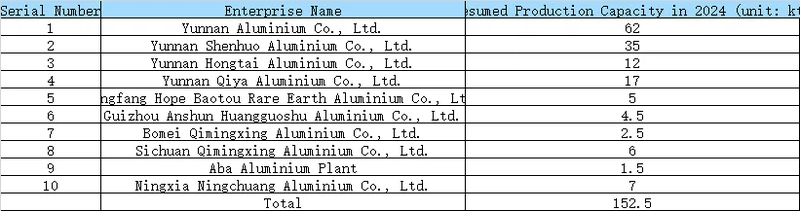
The resumed production capacity in 2024 was 1.525 million tons/year, mainly distributed in provinces such as Yunnan, Guizhou, and Sichuan. The resumed production capacity mainly came from the production capacity shut down due to power shortages in 2023, and a small part came from projects put into operation after technical transformation. In 2024, Yunnan had sufficient water supply from March onwards, and hydropower generation increased significantly. New energy projects such as wind power and photovoltaics were put into use faster, and thermal power units were put into full operation, effectively increasing power supply. At the same time, the electricity consumption of some other industries outside the aluminium industry declined to a certain extent, which also eased the pressure of tight power supply in the province for the past few years. Yunnan lifted its load management in March and electrolytic aluminium enterprises in the province quickly resumed production. In July, the operating capacity reached a historical peak of 5.78 million tons/year, and the production capacity remained at this level in the second half of the year, contributing a large increase in electrolytic aluminium production. In addition, since the implementation of the dual-carbon target, the electrolytic aluminium industry has become more and more demanding for energy-saving and carbon-reduction. Especially under the pressure of related policies such as tiered electricity prices and the electrolytic aluminium industry energy-saving and carbon-reduction plan, carbon reduction has become an urgent development strategy for enterprises, and more and more electrolytic cell upgrading and transformation projects are being carried out in areas such as large-scale trough-type, graphitization of cathodes, and intelligent management. Some technical transformation projects in Guizhou, Sichuan and other provinces/ regions have been put into operation, but due to the high production costs during production, the release schedule is relatively slow.
Table 2-2 Changes in China's Electrolytic Aluminium Resumed Production Capacity in 2024 (10,000 tons/year)
Source: Antaike
In 2024, the reduction capacity was 440,000 tons/year. Since the fourth quarter, the alumina price has soared, and the electricity price in some southwestern regions has also surged. The production costs of electrolytic aluminium enterprises have increased significantly, especially in regions with high costs such as Henan, Guizhou, Guangxi, and Sichuan, the production and operation pressure of aluminium plants is relatively high, and related enterprises have successively announced maintenance, production cuts or slowed down the pace of production resumption. Among them, the reduction in December was more concentrated. From the current situation of prices and cost inversion, the scale of future production cuts or maintenance is still expanding.
Table 2-3 Changes in China's Electrolytic Aluminium Reduction Capacity in 2024 (10,000 tons/year)

Source: Antaike
In 2024, Inner Mongolia surpassed Shandong for the first time and became the province with the highest electrolytic aluminium production capacity in China. Since 2013, Shandong has surpassed Henan and has been the largest electrolytic aluminium production base in China for 11 consecutive years. However, since 2018, due to the closure and exit of non-compliant projects in Shandong and the transfer of production capacity indicators, the production capacity scale in the province has continued to decline. During this period, Inner Mongolia and Yunnan have taken over most of the transfer indicators, and the scale of these two provinces has continued to expand. In 2024, Yidian Holding Group Co., Ltd. transferred the 200,000 tons/year electrolytic aluminium production capacity indicators of Yichuan Yuguang Longquan Aluminium Co., Ltd., a subsidiary of the group in Luoyang, Henan Province, to Chifeng Dongshan Aluminium Co., Ltd. in Inner Mongolia through internal transfer of the group's capacity. In addition, the Weiqiao Yunnan Honghe Project is still under construction and is expected to be put into production next year. In the future, with the further promotion of production capacity replacement, the proportion of Inner Mongolia, Yunnan and other provinces in the national capacity will still have room to increase, while the proportion of Shandong and Henan in the national capacity will further decline.
In 2024, the top five provinces/regions in China's electrolytic aluminium production capacity rankings were Inner Mongolia, Shandong, Xinjiang, Yunnan, and Gansu, with production capacity accounting for 15.0%, 14.5%, 14.2%, 14.2%, and 6.9%, respectively, an increase of 0.3%, -3.1%, -0.1%, 2.1% and 0.4% from 2022. From the perspective of production output, due to the deviation in statistical caliber during the capacity transfer process, individual provinces/regions may have production greater than capacity.
1.3 Electrolytic Aluminium Management Situation in China
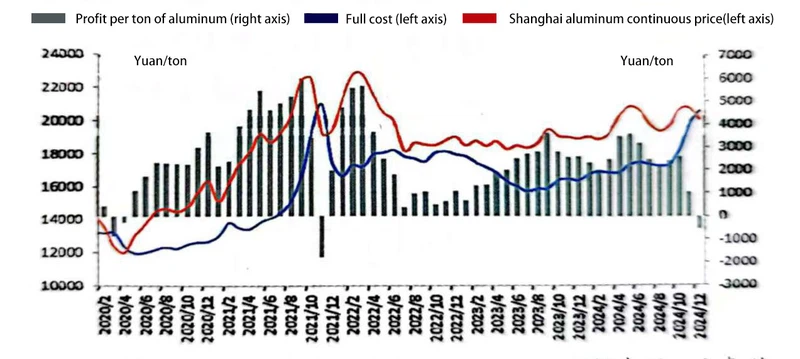
In 2024, although the fluctuation of alumina prices significantly raised the cost center of electrolytic aluminium, the aluminium price remained high throughout the year, and the electrolytic aluminium industry still maintained a profit above 2,000 yuan/ton, especially in May when the profit reached a maximum of 3,581 yuan/ton. According to Antaike's calculation, in 2024, China's weighted average fully cost of electrolytic aluminium (including tax) was 17,717 yuan/ton, an increase of 7.4% or 1,223 yuan/ton compared to the previous year; the average profit per ton of aluminium throughout the year was about 2,227 yuan, an increase of 0.9% or 20 yuan from the previous year.
Figure -4 Trends of China's Electrolytic Aluminium Cost and Theoretical Profit and Loss in 2024
Source: Antaike
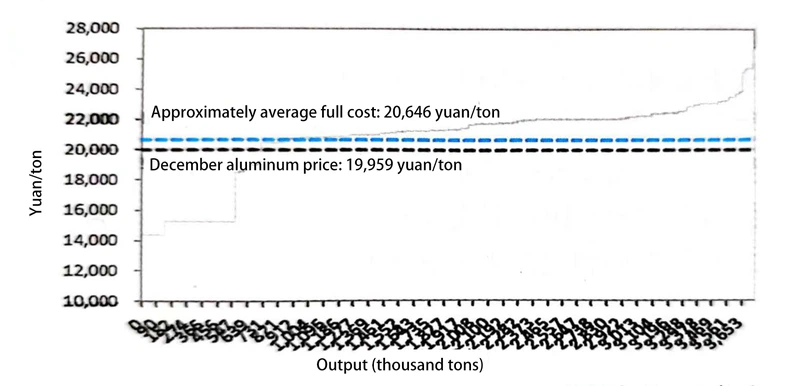
In terms of time, in the first half of the year, due to the insignificant increase in costs and the rapid rise in aluminium prices, the electrolytic aluminium industry's profits continued to increase, especially in the second quarter, when the industry achieved profitability for three consecutive months, and the profit margin of the ton aluminium remained above 3,000 yuan. In the third quarter, the electricity price in the off-season of the aluminium industry was relatively low, and the alumina price was relatively stable. The cost of electrolytic aluminium compared to the end of the second quarter declined slightly. Meanwhile, the aluminum price fell sharply during the same period, and the profit margin began to narrow, but it still exceeded 2,000 yuan/ton. Since the fourth quarter, the alumina price has surged, and the electricity price in the dry season has also increased significantly. The cost of electrolytic aluminium has shown a straight upward trend. The industry's loss has been expanding since November, and the average loss in December was 520 yuan/ton, the first monthly loss in nearly three years, and the proportion of loss in that month's production capacity reached 80%.
Figure 2-5 China's Electrolytic Aluminium Production Cost Curve in December 2024
Source: Antaike